· 2 min read
What Is a Solar Flare? Space Weather for Beginners
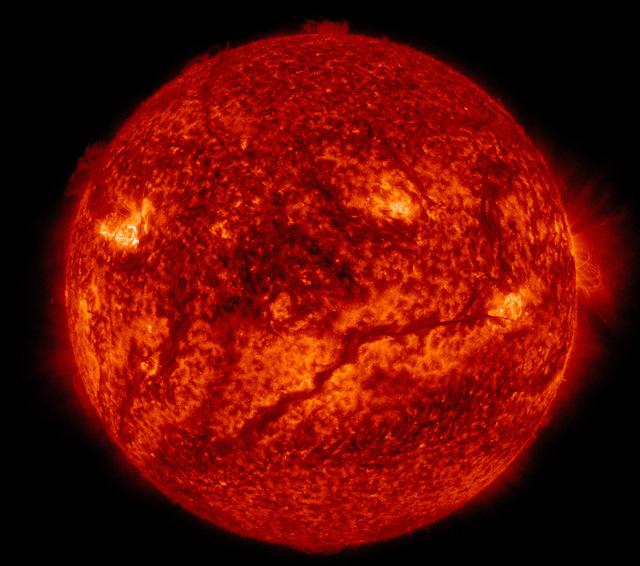
The Sun is a ball of electrically charged gas threaded with tangled magnetic fields. When those fields snap and reconnect, they release enormous bursts of energy. Together, these events are called space weather.
Solar flares
A solar flare is a sudden flash of X-ray and ultraviolet light from an active region on the Sun. Flares are classed by their X-ray brightness: A, B, C, M and X, where each letter is ten times stronger than the one before. An X2 flare is twice as strong as an X1. Strong flares can disrupt high-frequency radio on Earth's daylit side within minutes.
Coronal mass ejections (CMEs)
A CME is a vast cloud of magnetised plasma thrown off the Sun. It travels much more slowly than light, typically taking one to three days to reach Earth, if it is aimed our way at all.
Geomagnetic storms and the Kp index
When a CME or fast solar wind strikes Earth's magnetic field, it can trigger a geomagnetic storm. Storm strength is measured with the Kp index from 0 to 9. A Kp of 5 or more is a storm (NOAA levels G1–G5), and that is when auroras can be seen far from the poles.
Should I worry?
For people on the ground, no — the atmosphere and magnetic field protect us. Severe storms can affect satellites, GPS accuracy, radio and power grids, which is why agencies like NASA and NOAA monitor the Sun around the clock.